

JUSTICE AFTER DESTRUCTION
High-voltage investigations and partisan narratives are reshaping elections, distorting accountability and eroding trust — even as courts insist, rightly, on proof
JUSTICE AFTER DESTRUCTION
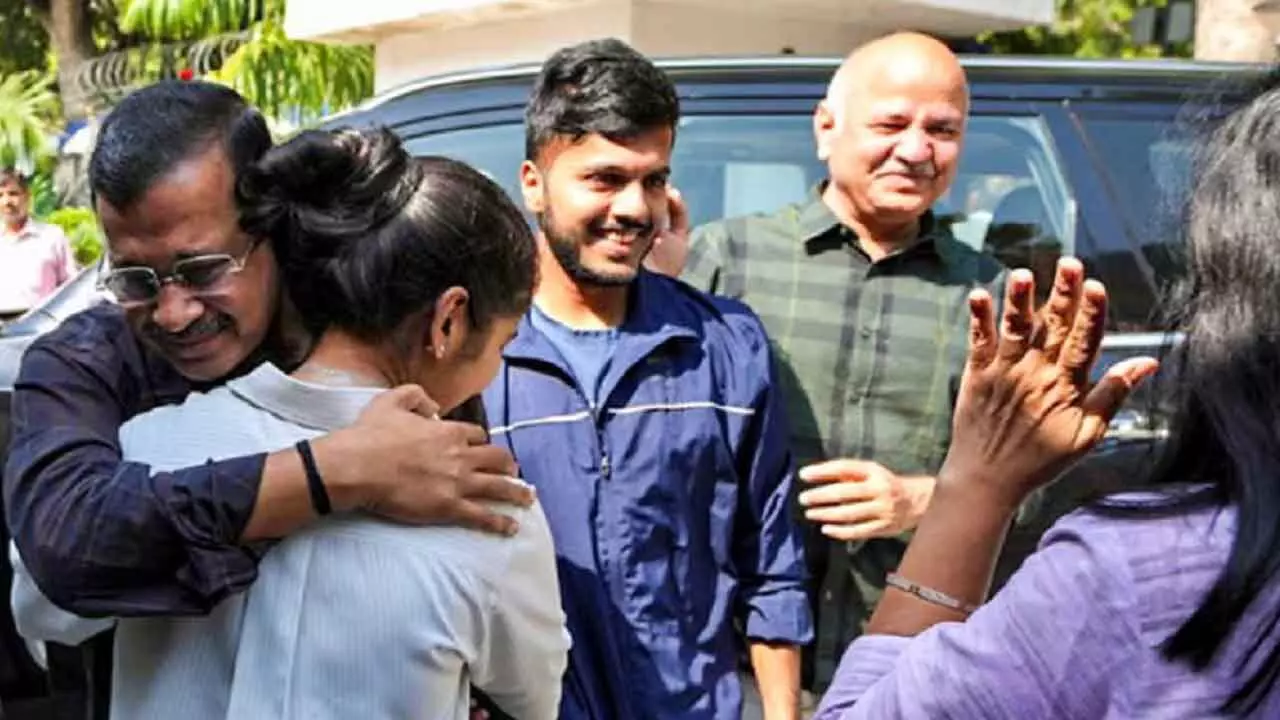
High-voltage investigations and partisan narratives are reshaping elections, distorting accountability and eroding trust — even as courts rightly insist on proof.
The collapse of the Delhi excise policy case against Arvind Kejriwal, Manish Sisodia and 21 others is not merely a courtroom development; it is a stress signal for India’s democratic institutions.
Arrest came first. Narrative followed swiftly. Judicial scrutiny arrived later — by which time the political damage had settled.
A Delhi court held that the prosecution had failed to establish even a prima facie case. What had been projected as a defining corruption scandal struggled to cross the first legal threshold. Months of raids, custody, asset attachments and primetime debate ultimately ran into a simple judicial demand: where is the evidence?
Kejriwal, Sisodia and others spent months in prison. Elections were fought under stigma. Reputations became daily fodder for accusation. Whatever one’s political position, the human and political cost of prolonged prosecution cannot be erased by a single court order. Relief does not restore lost time.
During proceedings, the Supreme Court raised pointed questions about the strength of the material relied upon. Judicial scepticism was visible then; it now appears vindicated.
The excise case was not the only weapon deployed. Running parallel was the “Sheesh Mahal” narrative — the claim that Kejriwal extravagantly renovated the chief minister’s residence with luxury fittings at public expense. The phrase was repeated until it hardened into presumed fact and became shorthand for alleged hypocrisy.
Today, however, there is no decisive prosecutorial validation and no courtroom endorsement matching that rhetorical certainty. The slogan has receded from daily discourse.
India has witnessed similar cycles before. The United Progressive Alliance government was politically defined by the 2G spectrum and coal allocation controversies. “2G” and “Coalgate” became shorthand for alleged systemic corruption, fuelling a nationwide anti-corruption movement led by Anna Hazare, with the likes of Arvind Kejriwal and Kiran Bedi among its prominent faces. That agitation reshaped electoral politics well before courts concluded their work.
In the coal allocation cases, there were arrests and convictions in specific block allocations, while several high-profile accused were later acquitted or discharged for lack of sufficient evidence; many proceedings stretched across years. In the 2G spectrum case, a special CBI court acquitted all accused in 2017, citing failure to prove charges beyond reasonable doubt, though appeals followed. The legal trajectory was complex, but the political consequences were swift: the UPA fell in 2014 and the BJP rose on a powerful anti-corruption wave.
Perception often outruns proof. Allegation travels faster than adjudication, and when scrutiny demands substantiation, the volume drops but the imprint remains.
The Delhi excise case itself moved quickly from investigation to campaign platform. Prime Minister Narendra Modi and Home Minister Amit Shah publicly referenced the alleged liquor scam in election rallies, presenting it as emblematic of corruption within the Aam Aadmi Party. Elections operate at the speed of rhetoric; courts operate at the pace of evidence. Voters decide in real time; judges decide after deliberation.
Sections of the broadcast media intensified this dynamic. Investigative leaks became breaking headlines. Arrests were treated as moral verdicts. Panel debates blurred the line between charge and conviction. Later judicial correction rarely received comparable prominence, despite the Constitution’s guarantee of due process and equality before the law.
This pattern is not confined to one state. In a February 2024 written reply to Parliament, the Finance Ministry stated that since 2014 the Enforcement Directorate had registered 193 cases against political persons but secured only two convictions — a disparity that underscores the wide gap between allegation and judicial proof.
Courts have repeatedly reminded investigative agencies that suspicion, however strong, cannot substitute proof. These are not technicalities; they are constitutional safeguards.
The issue is not whether politicians should be investigated. They must be. Public office demands accountability, and corruption, if proven, must invite punishment. The issue is consistency, timing and the integrity of investigation. In contemporary politics, accusation itself can function as punishment.
There is also the question of electoral oversight. Complaints alleging voter list irregularities and campaign malpractices have been formally submitted in recent contests. Visible, time-bound enforcement becomes essential in such circumstances. Democracy is measured not merely by turnout but by the credibility of its referees and the perception of a level playing field.
Jharkhand offers another instructive example. The Enforcement Directorate’s action against then Chief Minister Hemant Soren in connection with an alleged land scam led to his resignation and arrest at a politically charged moment. The case dominated headlines and reshaped state politics overnight. Legal proceedings remain contested, with courts examining the material placed before them and bail granted after extended custody. Meanwhile, voters delivered their own verdict at the ballot box.
Despite an intensive and sustained campaign by the BJP to frame the episode as proof of entrenched corruption, the narrative did not decisively sway the electorate. The episode underscores how investigative action and electoral consequence often intersect long before final adjudication — and how voters do not always follow the script set by political messaging.
Across states, opposition leaders have faced ED or CBI scrutiny at sensitive political junctures. Some have resigned, some have lost power and others have altered political alignments. In certain instances, investigative intensity appears to wane thereafter. Whether coincidence or context explains individual cases, the cumulative optics are damaging. Institutions must not only be impartial; they must be seen to be impartial.
The Supreme Court once described the CBI as a “caged parrot speaking in its master’s voice,” a constitutional warning against executive interference. Institutions exist to restrain power, not echo it.
The present government often invokes the Emergency of 1975 as a reminder of institutional overreach. That memory resonates because Indians instinctively distrust concentrated authority. Institutional independence, however, cannot be a selective virtue — demanded retrospectively and diluted contemporaneously.
To its credit, the judiciary has frequently acted as a corrective by scrutinising arrests, examining charge sheets and insisting on evidentiary thresholds. In the excise case, the finding that a prima facie case was not established is a substantive reminder of prosecutorial responsibility.
Yet constitutional maturity requires humility across all institutions. Former Chief Justice P.N. Bhagwati later acknowledged that the Supreme Court erred during the Emergency in the ADM Jabalpur case. Justice J.S. Verma observed that the judiciary is not above the Constitution. Justice V.R. Krishna Iyer cautioned that robes do not confer infallibility. Senior jurists such as Fali S. Nariman argued that independence and accountability must travel together.
No institution stands beyond scrutiny — not the executive, not investigative agencies, not Parliament and not even the judiciary. The Constitution remains supreme.
That is why repeated collapses of high-decibel political prosecutions matter. They raise questions about institutional health and fairness of process. Governments derive legitimacy from electoral victory, but moral authority also rests on procedural integrity.
Strengthening enforcement does not require weakening independence. Oversight must be meaningful, investigations must be rigorous and electoral complaints must be addressed visibly and impartially. Media must distinguish clearly between allegation and adjudication.
Short-term political gain from headline arrests may energise supporters, but long-term erosion of institutional credibility weakens the Republic. Democracies erode gradually when spectacle replaces substance and accusation replaces argument.
Years later, a court order may restore legal clarity, yet the political and institutional costs often linger.
India’s constitutional architecture rests on balance — executive, legislature, judiciary, election authorities and a free press operating within defined limits. When that balance tilts, trust suffers. Ultimately, the Constitution stands above all institutions. Its supremacy remains the only durable safeguard against the excesses of power.
(The columnist is a Mumbai-based author and independent media veteran, running websites and a youtube channel known for his thought-provoking messaging.)





